Quick Answer
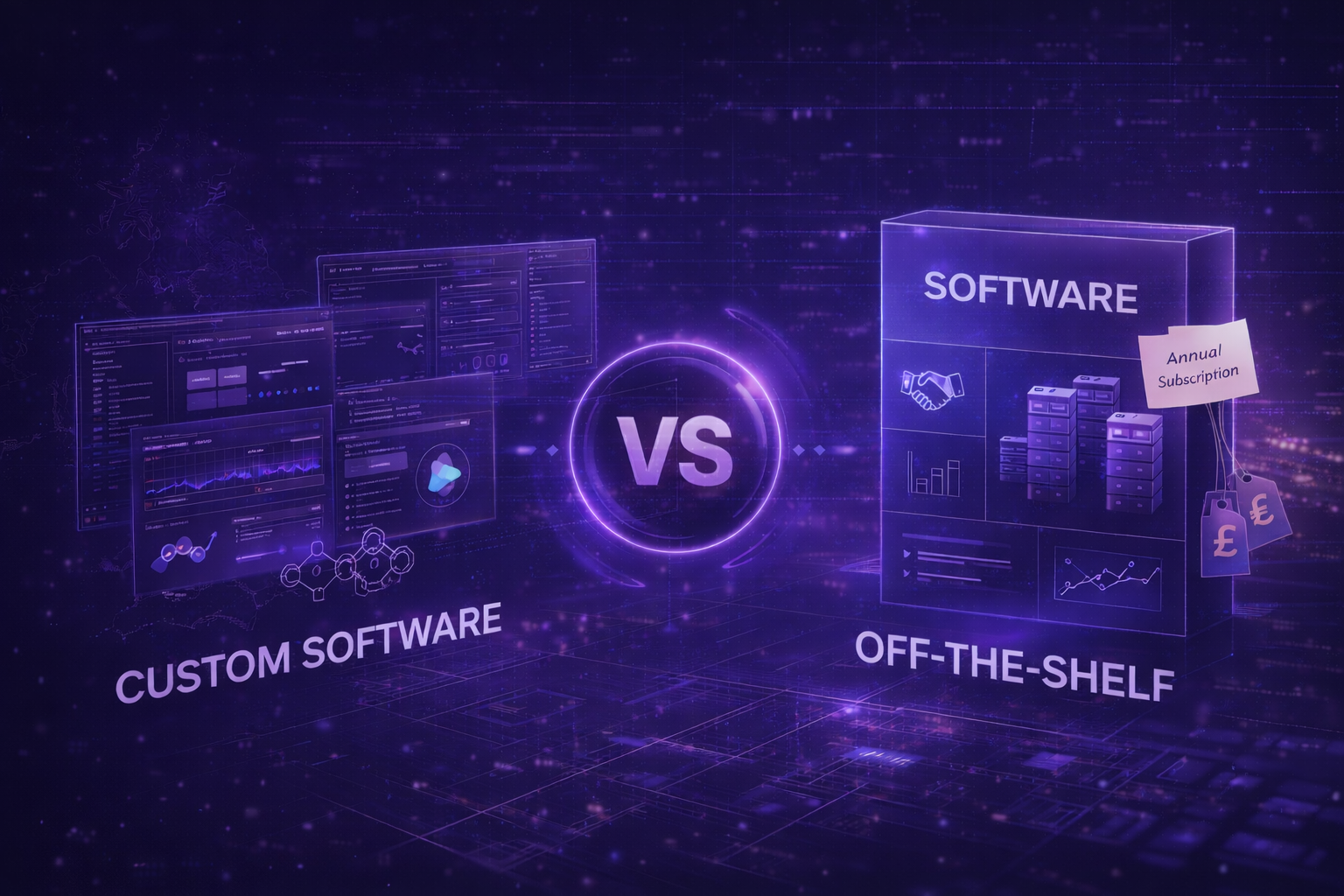
Custom software makes commercial sense when off-the-shelf tools cannot serve your process without significant compromise, when you are running multiple partially overlapping SaaS tools, or when manual workarounds are costing measurable staff time. The decision is not about budget preference. It is about whether a generic product can actually do the job your business needs done.
Key Steps
- 1Audit your current tools: list every SaaS subscription, its cost, and what gap it leaves
- 2Quantify the workarounds: estimate how many staff hours per week go to manual processes that software should handle
- 3Identify the process gaps: document where tools do not connect and what falls through
- 4Calculate the true cost of your current setup: subscriptions plus staff time plus error costs
- 5Compare that total against a scoped custom build with realistic ROI timeline
- 6Start with the highest-friction process, not the most ambitious system
Quick Facts
- UK businesses use an average of 13 different SaaS tools (Productiv, 2024)
- 42% of SaaS licenses go unused or underused in mid-size businesses (Zylo, 2024)
- Manual data entry errors cost UK SMEs an estimated £7.7 billion per year (CABA, 2023)
- Custom software ROI is typically realised within 12 to 24 months for focused projects
- The break-even point for custom vs SaaS commonly occurs at 15 to 30 users
- Process automation typically reduces task time by 40 to 80% for targeted workflows
Common Mistakes to Avoid
- Building custom software before exhausting what existing tools can do with proper configuration
- Scoping an entire platform in phase one instead of starting with the highest-value problem
- Not involving the people who use the process daily in requirements gathering
- Underestimating the cost of change management when replacing familiar tools
- Choosing a developer without proven experience integrating with your existing systems
SaaS tools are easy to argue for. They are fast to deploy, have no upfront cost, and the vendor handles maintenance. For most business problems, they are the right choice.
But there is a category of business problem where off-the-shelf software does not work. Not because the tools are bad, but because the tools were built for someone else.
This guide is about knowing the difference. Knowing when a subscription solves your problem, and when the subscriptions have become the problem.
What Off-the-Shelf Software Gets Right
Generic software exists because most business problems are not unique. Sending invoices, managing a project board, booking appointments, handling email: these problems have been solved at scale and the solutions work.
- Low upfront cost. Most SaaS tools charge monthly with no build fee
- Fast setup. A team can be using the tool the same day
- Vendor-managed maintenance and security updates
- Large user communities with documentation, training and support
- Integrations with other popular tools are usually pre-built
For businesses at an early stage or with common operational patterns, off-the-shelf is almost always the right starting point. The question is not whether to start with it. The question is when you have outgrown it.
Where Off-the-Shelf Software Breaks Down
The failure mode is rarely dramatic. It builds gradually.
A business starts with one tool. Then adds another to cover what the first one cannot do. Then a third to connect the first two. Then someone builds a spreadsheet to handle the gaps between all three.
According to Productiv's 2024 SaaS report, UK businesses use an average of 13 different SaaS applications. According to Zylo, 42% of those licences are unused or underused. The cost is not just financial. It is operational.
- Data lives in multiple places that do not talk to each other
- Staff spend time copying information between systems manually
- Reporting requires manual consolidation from multiple sources
- New staff take longer to learn which tool does what and when
- Processes are shaped by what the software allows rather than what the business needs
Talk Through Your Process Before Committing
Before scoping a custom build, we help you understand whether the problem genuinely requires custom software or whether a better-configured existing tool would solve it. No obligation, no pitch.
5 Warning Signs You Have Outgrown Off-the-Shelf Software
You Are Running the Same Data Through Multiple Systems
An order comes in through your website, gets manually entered into your CRM, then manually entered again into your ERP, then manually entered into your invoicing tool. Each transfer is a cost, a delay, and a source of errors. This is the most common indicator that a custom integration or unified system would pay for itself quickly.
Your Staff Have Built Spreadsheets to Cover the Gaps
When teams create spreadsheets to handle what the software cannot, it means the software is not doing the job. Spreadsheets are fragile, not auditable, and leave when the person who built them leaves. They are a symptom, not a solution.
Your Monthly SaaS Bill Has Grown But Your Processes Have Not Improved
More tools do not automatically mean better operations. If you are paying for five tools and the process still requires manual steps in between, the tools are not solving the problem. They are fragmenting it.
A Competitor Advantage Depends on How Your Systems Work
If part of your business value is in how fast you quote, how well you track project status, how efficiently you schedule, or how accurately you fulfil orders: that process is a competitive asset. Generic software gives the same process to everyone. Custom software builds the competitive advantage into the system.
Compliance or Data Control Requires a Managed Environment
Some sectors cannot use shared SaaS infrastructure for sensitive data. Healthcare, legal, financial services, and defence supply chains often require data to be held in controlled environments with auditable access. This is not a preference. It is a requirement, and standard SaaS cannot always meet it.
What Custom Software Actually Means
Custom software is not necessarily a large, complex platform. It is software built to solve a specific problem in your specific business.
That might be a single integration connecting two existing systems so data does not need to be re-entered. It might be an internal tool that replaces a spreadsheet. It might be a customer-facing portal that replaces a manual process.
The scope is defined by the problem, not by what is technically possible.
- System integrations: connecting existing tools so data flows automatically
- Internal tools: dashboards, management systems, reporting platforms built around your data
- Process automation: replacing manual workflows with software-driven equivalents
- Customer-facing platforms: portals, booking systems, configurators and self-service tools
- Full custom systems: when no combination of existing tools can do the job
The True Cost Comparison
The common mistake is comparing the build cost of custom software against the subscription cost of SaaS. The correct comparison includes everything.
True Cost of Off-the-Shelf
- +Monthly subscription fees per user
- +Additional licence tiers as team grows
- +Staff time spent on manual processes
- +Cost of errors from manual data transfer
- +Time spent managing multiple disconnected tools
- +Cost of workarounds that become permanent
True Cost of Custom Software
- +One-time development fee
- +Hosting (lower than SaaS at scale)
- +Maintenance and updates as required
- +No per-user licensing costs
- +Staff time recovered from manual processes
- +Competitive advantage that compounds over time
For businesses with 20 or more staff using a tool, the per-user SaaS cost often exceeds the equivalent custom build cost within 18 to 36 months. CABA estimates that manual data entry errors cost UK SMEs £7.7 billion per year. That is not a subscription cost. That is an operational cost that custom automation removes.
Real Example: Orderwise and Shopify Integration
A UK business was running Orderwise (an ERP platform) alongside a Shopify e-commerce store. Orders placed online had to be manually re-entered into Orderwise for fulfilment. Stock levels had to be manually updated in both directions.
Neither platform offered a native integration that handled the specific product structure and order logic this business used. The manual process was creating delays, errors, and staff overhead that grew with every order.
We built a custom integration that automated the full order pipeline: orders from Shopify pushed into Orderwise automatically, stock levels synchronised in both directions, and fulfilment status returned to the customer without manual intervention.
“His enthusiasm for the task in hand is something that you rarely come across.”
Result: fully automated order pipeline, manual overhead eliminated, staff time redirected to higher-value work.
Frequently Asked Questions
Off-the-shelf software is built for a broad market and adapted to your business. Custom software is built specifically for your processes from scratch. Off-the-shelf is faster and cheaper to start. Custom software is more expensive upfront but removes all the compromises that come with generic tools.
Custom software makes sense when your processes cannot be adequately served by available tools, when you are paying for multiple SaaS tools with overlapping functions, when manual workarounds are consuming significant staff time, when a competitive advantage depends on how your systems operate, or when compliance requires a controlled data environment.
SaaS tools typically cost £50 to £500 per user per month. Custom software costs £10,000 to £150,000+ to build depending on complexity, with lower ongoing costs. The ROI calculation depends on team size, current subscription costs, and the value of time saved by removing manual processes.
It depends on the problem. Custom software is worth considering when the combined cost of manual workarounds, multiple subscriptions, and process inefficiencies exceeds the cost of building something purpose-built. Many businesses find the tipping point arrives earlier than expected.
A focused custom software project typically takes 8 to 24 weeks from scoping to launch depending on complexity. A simple automation tool or internal dashboard may take 6 to 10 weeks. A complex platform with multiple system integrations may take 4 to 9 months. Phased delivery is usually the most practical approach for larger projects.
Still have questions?
Get in TouchRelated Services
Related Reading
If Your Process Does Not Fit the Tool, Build the Tool Around the Process
At Delaney Industries, we build custom software and system integrations for businesses that have outgrown generic tools. We start with the problem, not the technology. If you are unsure whether custom software is the right answer, talk to us first. We will tell you honestly if it is not.